

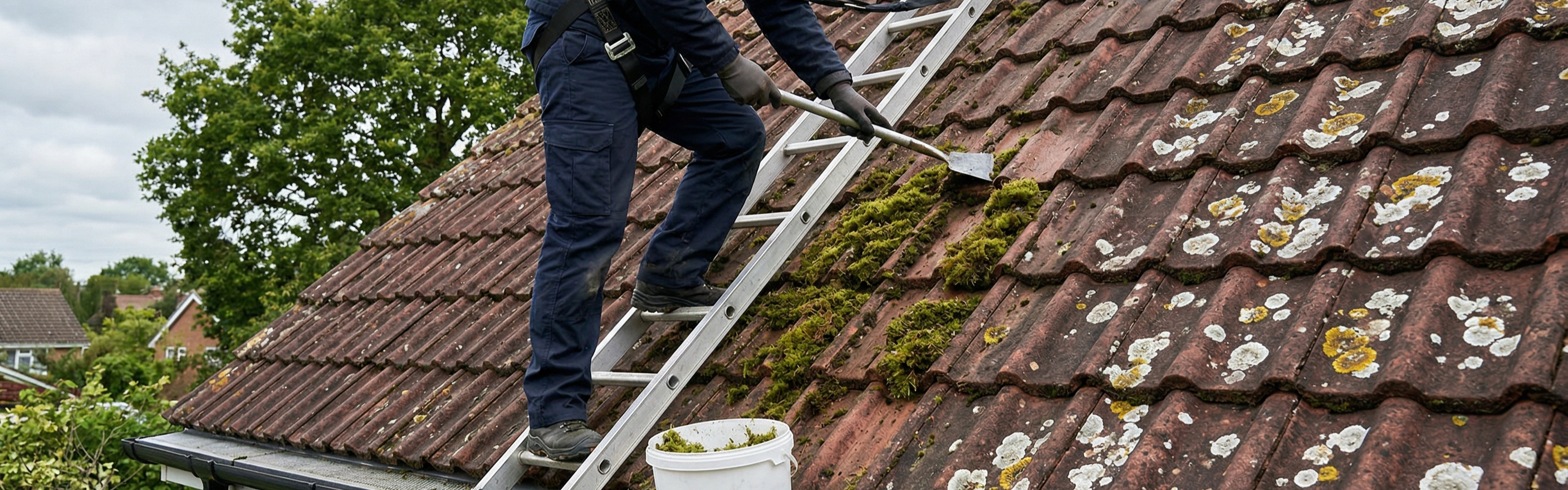
Si vous scellez ou peignez un toit sans éliminer complètement la mousse et le lichen, le revêtement échouera en une seule saison. Ces organismes biologiques ne sont pas seulement des imperfections de surface, ils s'ancrent dans vos tuiles avec des racines microscopiques. S'ils sont piégés sous un film de peinture, ils continueront à se développer en recherchant l'humidité, rompant physiquement le lien entre la peinture et la tuile. Pour éviter cela, vous devez utiliser un nettoyant biocide spécialisé qui tue les spores à la racine avant l'application de tout revêtement.
-
Dommages structurels : La mousse retient l'humidité contre la tuile, ce qui entraîne des fissures dues au gel-dégel et des fuites éventuelles.
-
Barrière d'adhérence : Le lichen crée un biofilm cireux et hydrofuge qui empêche la peinture de « mouiller » et de coller à la surface de la tuile.
-
La solution biocide : Contrairement au seul lavage sous pression, un biocide neutralise chimiquement les spores, garantissant que le toit reste biologiquement stérile avant d'être scellé.
Le défi de la « tache blanche » : pourquoi le lichen est si tenace
La mousse est relativement facile à enlever avec un grattoir mécanique, mais le lichen – ces petites taches circulaires croûteuses blanches ou jaunes – est un colonisateur bien plus agressif. Le lichen est une relation symbiotique entre les algues et les champignons. Il produit un acide qui dissout en fait les minéraux de vos tuiles pour créer une adhérence.
Si vous nettoyez simplement le toit au nettoyeur haute pression, vous pourriez enlever le « bouclier » de lichen visible, mais les racines microscopiques restent incrustées dans les pores de la tuile. Si vous appliquez ensuite une peinture ou un scellant de toit, vous avez fourni à ces racines un auvent protecteur.
Le rôle des nettoyants biocides
Un biocide est un lavage chimique conçu pour tuer la croissance organique sans avoir besoin d'eau à haute pression, qui peut souvent endommager la surface des vieilles tuiles. Les biocides agissent en perturbant les parois cellulaires de la mousse et du lichen.
Comprendre les concentrations de biocide
Toutes les tuiles ne sont pas faites du même matériau, et l'utilisation d'un biocide trop agressif peut entraîner une dégradation de la surface ou un « brûlage » du substrat.
|
Type de tuile |
Concentration de biocide recommandée |
Pourquoi ? |
|
Tuiles en béton |
Haute concentration (qualité professionnelle) |
Le béton est très poreux et peut supporter des biocides fortement alcalins ou oxydants pour atteindre les racines de lichen profondément ancrées. |
|
Ardoise (naturelle) |
Concentration moyenne |
L'ardoise naturelle est dense ; un biocide de concentration moyenne suffit à tuer la croissance superficielle sans tacher la pierre naturelle. |
|
Tuiles en terre cuite / tuiles plates |
Faible à moyenne concentration |
Les vieilles tuiles en terre cuite peuvent être cassantes et sujettes au « délaminage ». Un biocide plus doux prévient le stress chimique sur la céramique vieillie. |
|
Fibrociment |
Faible concentration |
Ces tuiles contiennent souvent des liants délicats qui peuvent être affaiblis par des lavages chimiques très concentrés. |
Le processus de préparation correct
Pour garantir que votre peinture ou scellant de toit dure toute sa durée de vie nominale, vous devez suivre ce processus de décontamination biologique :
1. Grattage mécanique
Enlevez la majeure partie des « gros » coussins de mousse à l'aide d'un grattoir manuel. Cela permet au biocide d'atteindre directement la surface de la tuile plutôt que d'être gaspillé en s'imprégnant dans la mousse.
2. L'application du biocide
Appliquez le biocide choisi à l'aide d'un pulvérisateur basse pression. Assurez-vous que le toit est sec avant l'application afin que les tuiles soient « assoiffées » et tirent le produit chimique profondément dans leurs capillaires.
-
Le temps d'action : La plupart des biocides professionnels nécessitent un « temps de contact » de 24 à 72 heures pour tuer complètement les rhizoïdes de lichen. Vous verrez les taches blanches devenir grises ou noires à mesure qu'elles meurent.
3. Le rinçage neutre
Une fois que le biocide a fait son travail, le toit doit être rincé abondamment. Cela élimine les matières biologiques mortes et tout résidu chimique. Si vous peignez sur le résidu de biocide, cela peut interférer avec la chimie de la peinture, conduisant à une finition douce ou collante.
Compromis honnêtes : Biocide vs Nettoyage Haute Pression
L'illusion de l'« instantané » : Le nettoyage haute pression donne un aspect « propre » instantané, mais il fait souvent plus de mal que de bien en enlevant la finition protectrice « sablée » des tuiles en béton et en introduisant de l'eau dans l'espace sous toiture. Un biocide met plus de temps à agir, mais offre un nettoyage beaucoup plus profond et durable.
Respect de l'environnement : Les biocides sont des produits chimiques puissants. Vous devez vous assurer que tout ruissellement est détourné des bassins de jardin et que vos gouttières sont déconnectées de tout réservoir de récupération d'eau de pluie pendant le processus de nettoyage.
La fenêtre de survie : Même après un traitement biocide, si un toit n'est pas peint pendant plusieurs mois, de nouvelles spores atterriront et commenceront à se développer. Pour des résultats optimaux, vous devriez viser à sceller ou à peindre le toit dans les 7 à 14 jours suivant le rinçage biocide.
Partager:
Importance d'une météo claire pendant la période de séchage pour la peinture de toiture