
Les taches d'huile sont l'ennemi de la peinture de sol.
Si vous appliquez un revêtement en résine sur une couche de graisse, même microscopique, vous avez la garantie d'une défaillance d'adhérence. La résine ne peut pas adhérer au béton ; elle se pose sur l'huile, finissant par se fissurer et se décoller sous la chaleur des pneus de voiture.
Nous le constatons constamment dans les garages et ateliers plus anciens. Un client nettoie le sol au jet d'eau sous pression, pense qu'il est propre et le peint. Trois semaines plus tard, la peinture se décolle exactement à l'endroit de l'ancienne tache d'huile.
Le nettoyage du béton contaminé par l'huile nécessite plus que de l'eau et des efforts. Il faut de la chimie. Ce guide explique comment dégraisser correctement un sol pour s'assurer que votre nouveau système adhère réellement.
La science : pourquoi "eau et savon" ne suffit pas
Le béton est poreux, comme une éponge dure. Lorsque l'huile s'y dépose, elle ne reste pas seulement à la surface ; elle s'infiltre profondément dans les capillaires de la dalle.
Les détergents ménagers standard ou le liquide vaisselle peuvent nettoyer la surface, mais ils n'ont pas la capacité de solvabilité nécessaire pour extraire l'huile des pores. De plus, un nettoyage agressif au jet d'eau sous pression sans les bons produits chimiques a souvent pour effet de faire pénétrer l'huile plus profondément dans le béton plutôt que de l'enlever.
Pour résoudre ce problème, vous avez besoin d'un émulsifiant de force industrielle, plus précisément un Dégraissant Béton robuste.
Le diagnostic : le test de la goutte d'eau
Avant de commencer (et après avoir terminé), vous devez tester la surface. Versez une tasse d'eau sur la zone tachée.
-
Si l'eau perle : L'huile agit efficacement comme un scellant. La peinture n'adhérera pas ici.
-
Si l'eau s'étale (fonce le béton) : La surface est ouverte, mais de l'huile profonde peut encore être présente.
Processus de remédiation étape par étape
1. Appliquer le dégraissant (pur ou fortement dilué)
Ne pré-humidifiez pas le sol avec de l'eau, car cela remplit les pores que vous essayez de nettoyer. Appliquez votre Dégraissant Industriel directement sur les taches d'huile.
-
Pour les dépôts importants : Utilisez-le pur (non dilué).
-
Pour la saleté générale : Diluez selon la fiche technique.
2. L'agitation est obligatoire
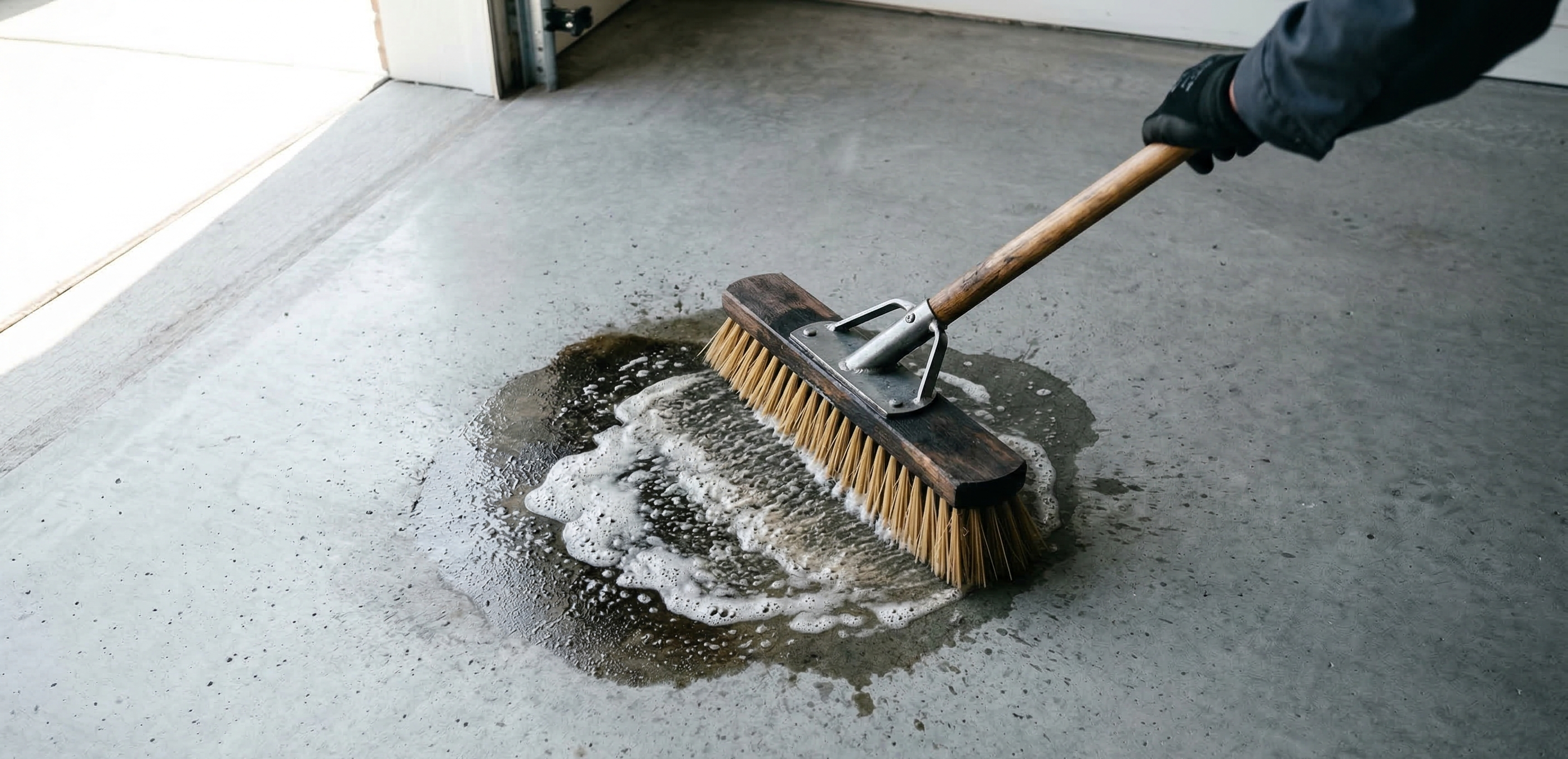
Le simple fait de pulvériser le produit chimique ne suffit pas. Vous devez agiter mécaniquement la surface pour briser la tension superficielle et mélanger l'huile avec l'émulsifiant. Utilisez une brosse à récurer à poils raides ou une machine à laver les sols rotative. Frottez la zone vigoureusement pendant 5 à 10 minutes. Vous voulez voir une boue sale et mousseuse se former.
3. Le temps de "pose"
Laissez agir le produit chimique. Laissez-le pénétrer dans les pores et décomposer les chaînes hydrocarbonées pendant 10 à 15 minutes. Ne le laissez pas sécher ; s'il commence à sécher, humidifiez-le légèrement avec un peu d'eau.
4. Extraction (étape cruciale)
C'est là que la plupart des bricoleurs échouent. Si vous ne faites que rincer le sol, vous ne faites souvent que répandre la boue huileuse sur le reste du sol propre. Idéalement, vous devez extraire le liquide sale. Utilisez un aspirateur à eau pour aspirer la boue. Une fois la majeure partie retirée, vous pouvez ensuite nettoyer soigneusement la zone au jet d'eau sous pression avec de l'eau chaude (si disponible) pour éliminer les résidus restants.
Quand les produits chimiques ne suffisent pas : pénétration profonde
Si vous avez affaire à une fosse de mécanicien ou à un atelier où l'huile a imprégné le béton pendant 20 ans, le dégraissage chimique pourrait ne pas être assez efficace. Dans ces cas extrêmes, le béton est contaminé de manière permanente.
-
Option A : Le ponçage au diamant pour enlever les 2-3 mm supérieurs de béton saturé.
-
Option B : L'utilisation d'un "Apprêt tolérant à l'huile" spécialisé.
Conclusion
Vous ne pouvez pas précipiter le dégraissage. C'est l'étape la plus critique de la préparation des sols de garage.
Effectuez à nouveau le test de la goutte d'eau après le nettoyage. Si l'eau perle toujours, vous devez dégraisser à nouveau. Ne peignez pas tant que l'eau ne s'est pas étalée rapidement et uniformément.
Une fois l'huile éliminée et le sol sec, vous devez apprêter immédiatement pour sceller les pores contre toute contamination future. Pour les sols précédemment huileux, nous recommandons fortement d'utiliser notre Apprêt Époxy sans solvant pour une adhérence la plus forte possible.
Partager:
Quand et comment graver le béton à l'acide en toute sécurité
Qu'est-ce que la laitance ? Pourquoi il faut enlever la surface farineuse