
You pull the car onto the drive. You get out. You walk into the hallway. Crunch, crunch, crunch. You look at the soles of your shoes, and they are embedded with tiny black stones. Your driveway is disintegrating.
This is called Fretting. It is the first sign that your tarmac is dying. The "glue" (bitumen) that holds the stones together has dried out, causing the surface aggregate to detach and scatter. If you ignore it, "fretting" turns into "potholes," and you will be facing a £5,000 bill for a new driveway.
But if you catch it early, you can freeze the process. You can "reglue" the surface. Here is how to stabilise a crumbling tarmac drive and buy yourself another 5 years of life.
1. Why is it Happening? (Oxidation)
Tarmac (Asphalt) is simple. It is stone mixed with sticky bitumen. When new, bitumen is flexible and oily. However, UV radiation and oxygen attack the bitumen over time. They strip away the oils, making the binder brittle and weak. Eventually, the grip of the binder becomes weaker than the friction of your car tyres. Every time you turn your steering wheel, you rip a handful of stones out of the surface.
2. The Solution: Binder Reinforcement
You cannot simply paint over loose stones. Paint is too thin; it will just colour the grit black without holding it down. You need a product specifically designed to replace the lost structural resins.
These are Acrylic or Polyurethane Tarmac Binders (often sold as heavy-duty Tarmac Restorers).
-
The Physics: Unlike paint, these fluids are designed to flow between the stones. They settle in the micro-cracks and harden into a durable, flexible resin that acts as a fresh adhesive.
-
The Limit: This works for Surface Fretting (loose grit/dust). It does NOT work for structural crumbling (large chunks breaking off). If you have holes deep enough to put your thumb in, you need Cold Lay Tarmac repair putty, not a liquid binder.
3. The Preparation: Don't Scrub Too Hard
This is the tricky part. You need to clean the surface to get the binder to stick, but the surface is fragile. If you blast it with a high-pressure Turbo Nozzle, you will rip half the driveway up.
-
Sweep: Use a stiff broom to remove all the loose, rattling stones. Be aggressive. If a stone is loose, you want it out now, not later.
-
Soft Wash: Use a hose or a pressure washer on a low setting (fan spray) to wash away the dust and moss.
-
Kill the Moss: Moss roots break tarmac apart. Apply a fungicidal wash to ensure nothing is growing in the cracks.
4. The Application: Saturation is Key
To stop fretting, you can't just apply a thin skim coat. You need to saturate the surface.
-
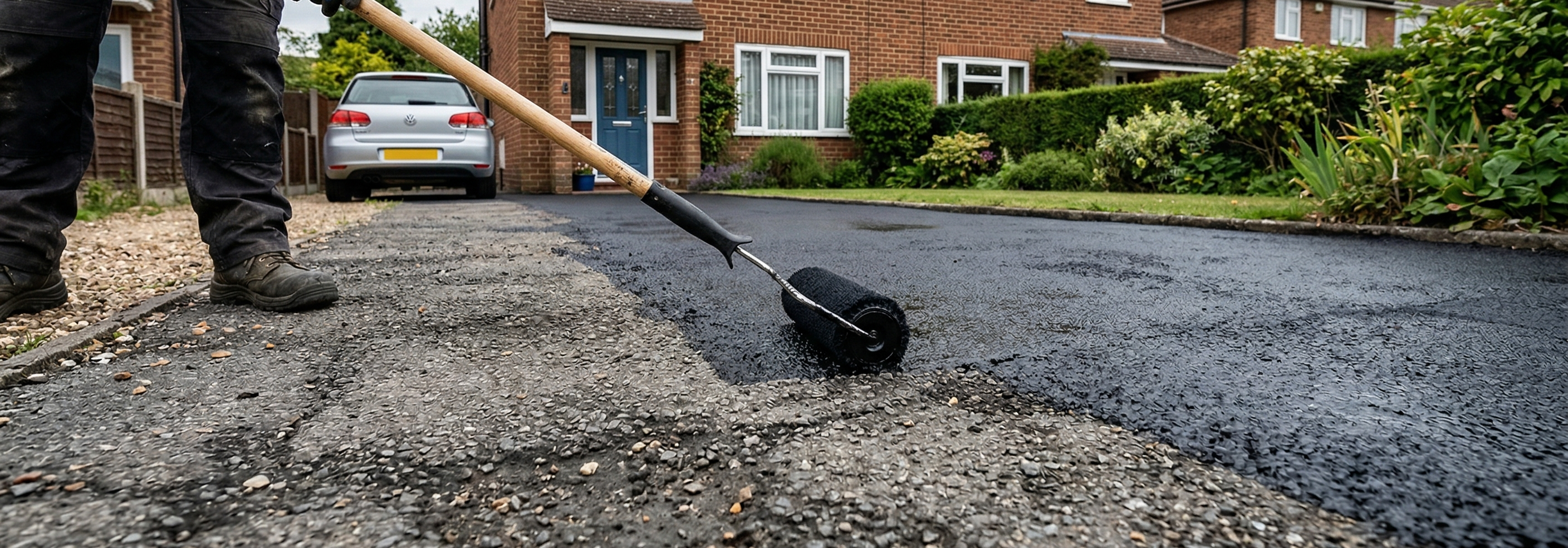
Coat 1 (The Soak): Apply the binder generously. You want it to soak into the porous matrix.
-
Tip: Use a long-handled roller. Push the liquid into the texture.
-
Coat 2 (The Cap): Apply a second coat 2–4 hours later. This seals the surface and locks the aggregate in.
5. Managing Expectations
It is important to be realistic.
-
Will it look new? Yes, it will be jet black and uniform.
-
Will it stop ALL loose stones? It will stop 90–95%. However, if you have a heavy SUV and you turn the power steering while stationary on a hot day, you will still tear some stones up. This is unavoidable on old surfaces.
-
How long will it last? A good stabilisation treatment typically lasts 3–5 years before the resin wears down and needs topping up.
6. Cold Lay Repair (For the Bad Bits)
If you have patches that are too far gone for liquid stabiliser (i.e., actual holes), you must patch them before you coat the whole drive.
-
Use Cold Lay Macadam: This comes in bags.
-
The Trick: Warm the bag up (leave it in the sun or a warm room). It makes the tar much stickier and easier to compact.
-
Compact Hard: Use a club hammer or a tamper. Loose repair patches will fail instantly.
-
Seal Over It: Once the patch is hardened, roll your Tarmac Binder over the entire driveway (including the patch) to blend it all into one uniform black colour.
Conclusion
Fretting is a warning shot. Your driveway is telling you it is thirsty. Don't wait for the potholes to appear. If you stick the stones back down now with a heavy-duty binder, you save the structural integrity of the base.
-
Sweep off the loose grit.
-
Apply a heavy coat of Binder.
-
Stop turning the wheel when stationary.
Share:
Treating Moss and Algae on Soft Tarmac Surfaces
How to Clean Oil and Rust Stains on Block Paving