
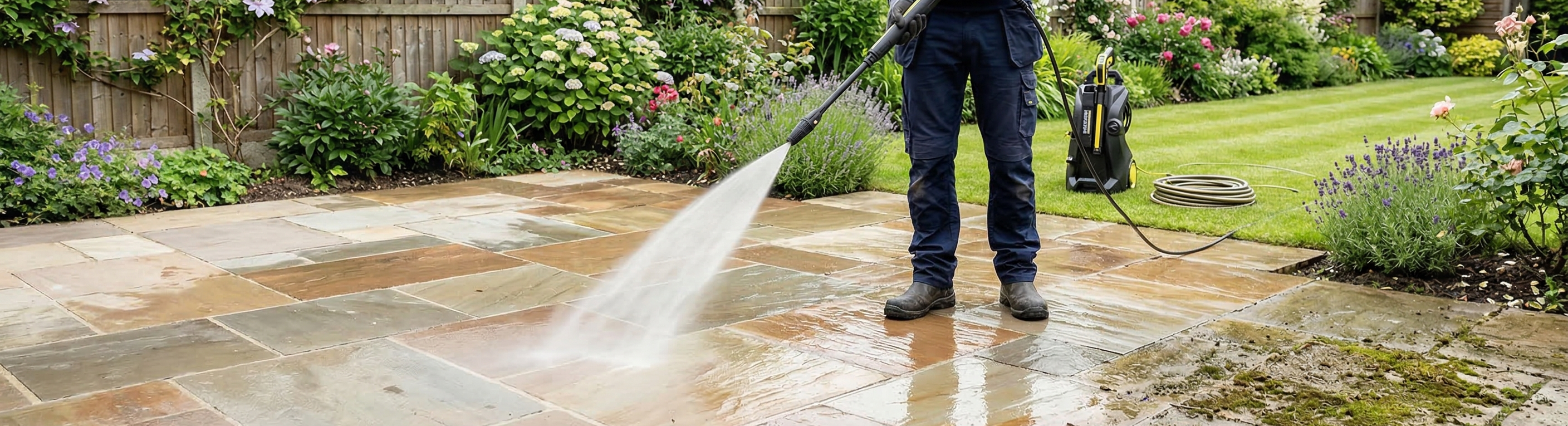
Spring arrives, and the sound of pressure washers echoes across every neighbourhood in the UK. It is incredibly satisfying to blast a winter’s worth of slime off your patio and watch the original stone colour reappear.
But there is a fine line between cleaning a patio and destroying it.
A pressure washer is effectively a water-knife. If you use the wrong nozzle or hold it too close, you can strip the surface off expensive Indian Sandstone, blow the pointing out of your joints, and leave "tiger stripes" etched into the stone forever.
Before you pull the trigger, read this guide on the critical dos and don'ts of pressure washing patio surfaces.
DON'T: Use the "Turbo Nozzle" on Soft Stone
Your machine likely came with two attachments: a Fan Nozzle (adjustable spray) and a Turbo Nozzle (a spinning ball bearing).
The Turbo Nozzle is designed for stubborn dirt on hard concrete. It is incredibly aggressive.
-
The Risk: If you use a Turbo Nozzle on natural stone (Sandstone, Limestone, or Slate), it will likely strip the top layer of the stone off. We often see patios that have been pitted and scarred because the jet was too powerful.
-
The Fix: Always stick to the Fan Nozzle or a "Flat Surface Cleaner" (the round patio attachment). These spread the pressure evenly.
DO: Use Chemicals to Do the Heavy Lifting
If you are relying 100% on water pressure to remove black lichen spots, you are working too hard - and risking damage. Black spots are dug deep into the stone. To blast them out with water, you have to hold the lance an inch from the surface. This is dangerous.
→ Check out our blog on Black Spots and Lichen Removal for more in-depth information.
Instead, apply a Sodium Hypochlorite Patio Cleaner first. Let the chemical kill the lichen and soften the dirt for 30 minutes. Then, you can rinse it off with a gentle medium-pressure wash, saving your stone from a high-pressure beating.
DON'T: Aim Straight Down at the Joints
The mortar or sand between your slabs is the weakest part of the patio. If you aim the lance directly into the joint, you will blow it out.
-
The Consequence: Once the pointing is gone, water gets under the slabs. In winter, that water freezes, expands, and pops your slabs loose (Frost Heave).
-
The Fix: Hold the lance at a 45-degree angle. Wash the dirt off the patio, not out of the patio.
DO: Re-Sand Immediately
Even if you are careful, you will likely displace some jointing sand (especially on block paving). Don't leave the gaps open. As soon as the patio is dry, sweep fresh Kiln Dried Sand into the joints. This stabilises the blocks and stops weeds from rushing into the empty gaps.
DON'T: Forget the Drainage
Before you start, check where the water is going. You are about to unleash hundreds of litres of dirty sludge. If your patio slopes towards a drain, make sure that drain isn't blocked with leaves. If the sludge dries in the drain trap, it turns into concrete.
-
Pro Tip: Lift the drain cover and put a filter (or even a ball of wire mesh) in there to catch the heavy moss, then empty it when you finish.
DO: Seal It When You Finish
After you have spent all day cleaning, do you really want to do it again in six months? Pressure washing opens the pores of the stone, making it more absorbent to water and green algae.
Once the patio is bone dry (usually 2-3 days later), lock in that clean look with a high-quality Patio Sealer. This puts an invisible raincoat over the stone. Next year, you won't need the heavy pressure washer - a quick hose down will be enough.
Conclusion
A pressure washer is a tool, not a magic wand. If you find yourself having to hold the nozzle an inch from the ground to remove a stain, stop. You are damaging the stone. Switch to a chemical cleaner like our Industrial Patio Cleaner, let the chemistry do the work, and save the pressure for rinsing.
Share:
Removing Black Spot Lichen: Why Pressure Washing Isn't Enough
Degreasing Concrete: How to Remove Oil Stains Before Painting