
You have bought the sealer, checked the weather forecast and you feel ready to crack on with the job. But if you rush the cleaning stage, you'll be wasting your time and money.
If there is dust, oil, moss, or algae on the surface, the sealer will bond to the dirt, not the concrete. Within six months, the sealer will lift, peel, and flake off, taking the dirt with it. Not to mention, with our transparent sealers, you'll be sealing in dirt that will still be visible.
To get a bond that lasts for 5 years and looks great, you need to perform a Deep Clean. This involves two distinct stages: Chemical Degreasing and Mechanical Washing. Here is the professional protocol for prepping a surface until it is clinically clean.
Stage 1: The Chemical Clean
Water alone does not remove grease. Concrete is porous. Over the years, exhaust fumes, barbecue fats, and motor oils have soaked into the capillaries of the stone. Even if you can't see a stain, the microscopic oil residue acts as a "bond breaker" for acrylic sealers.
The Protocol:
-
Apply Degreaser: Use a specialized Industrial Alkaline Degreaser.
-
Dilution: For general cleaning, dilute 1:10 with water. For visible oil spots, use it neat.
-
Agitate: This is the most important part. Use a stiff deck brush to scrub the chemical into the surface. You need to physically loosen the grime from the pores.
-
Dwell Time: Leave it for 15–20 minutes. Do not let it dry out (mist it with water if it's a hot day).
Stage 2: The Mechanical Clean (Pressure Washing)
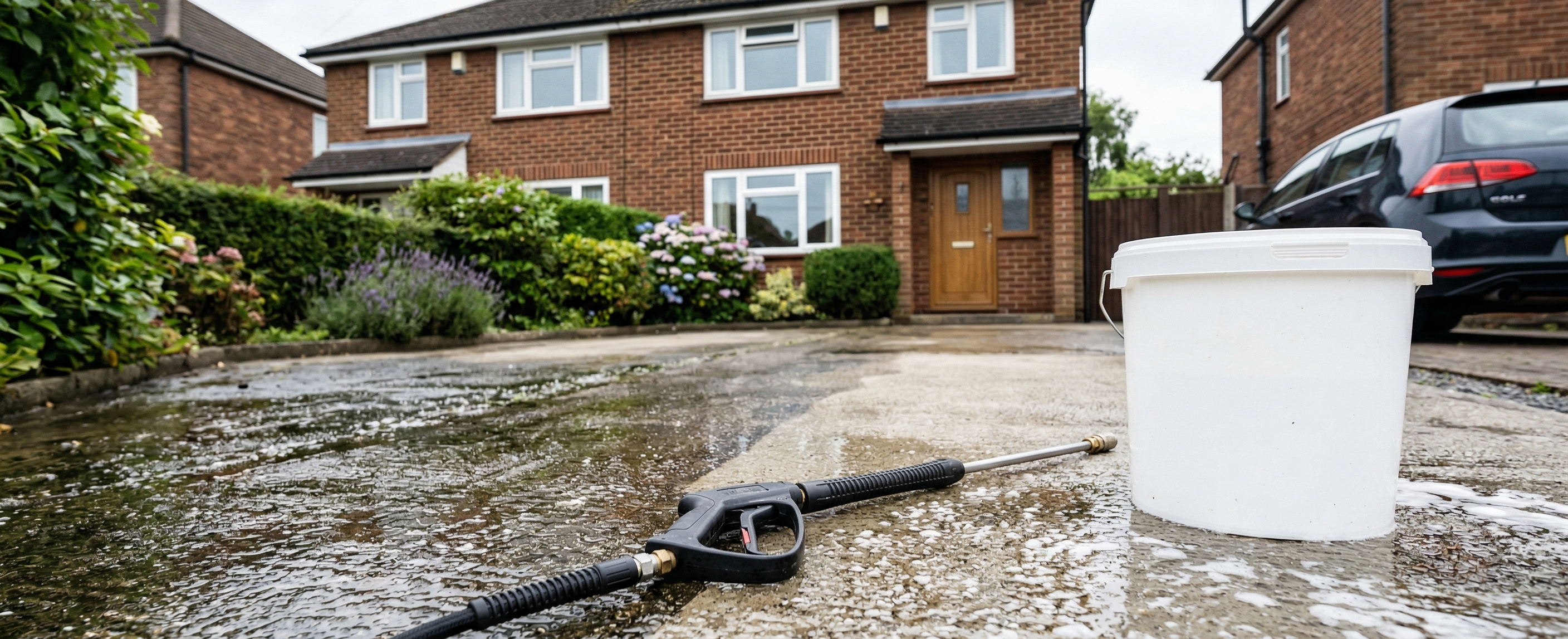
Now that the chemical has loosened the dirt, you need to blast it out. A garden hose is not enough. You need a pressure washer with at least 2000 PSI (130 Bar).
The Nozzle Choice:
-
For Concrete / Block Paving: Use a Turbo Nozzle (Rotary Tip). This spins a zero-degree jet in a circle, providing maximum impact to rip out moss and deep dirt.
-
For Tarmac / Natural Stone: Use a Fan Tip (Variable Lance). A turbo nozzle is too aggressive and will damage softer surfaces.
The Technique:
-
Systematic Passes: Don't just wave the wand around. Clean in straight lines, overlapping each pass by 50%.
-
The Angle: Hold the lance at 45 degrees. If you spray directly down (90 degrees), you drive the dirt deeper into the sand joints.
-
Rinse: Once the dirt is lifted, switch to a low-pressure hose to flood the area and chase the dirty water into the drain.
Dealing with Lichen (Black Spots)
If, after pressure washing, you still see black ink-like spots on your patio, stop. This is Black Spot Lichen. Pressure washing will not remove it (the roots are deep in the stone).
-
The Fix: You must apply a Biocide based remover after the initial wash. Let it dwell for 30 minutes to kill the spores, then rinse again.
Drying Time
This is where most DIY projects fail. You have just flooded the concrete with thousands of litres of water. The slab is now saturated (soaked through). If you apply a solvent-based sealer while the concrete is wet, you will trap moisture.
-
The Result: The sealer will turn white (bloom) and bubble up as the water vapor tries to escape.
The 3-Day Rule:
-
Summer: Wait at least 48 hours of dry, warm weather after washing.
-
Spring/Autumn: Wait at least 72 hours.
-
The Touch Test: The surface might look dry in 2 hours, but the moisture deep down is still there. If the paving joints (sand) are dark/damp, do not seal.
Re-Sanding (For Block Paving Only)
If you are sealing block paving, your pressure washer will have blown some of the jointing sand out.
-
Wait until dry: You cannot sweep sand into wet joints.
-
Refill: Sweep fresh Kiln Dried Sand into the joints until they are full.
-
Clean the Face: Ensure all sand is swept off the top of the bricks before sealing. If you seal loose sand onto the face of the block, it will look like sandpaper forever.
Conclusion
Preparation takes longer than sealing, that’s just the way it is if you want the job done right. The sealing itself takes 2 hours. The cleaning and drying takes 3 days. Don't rush the dry time. If you seal moisture in, you will spend twice as long trying to fix the white bloom later.
-
Degrease first
-
Turbo wash second
- Let it bone dry
Ready to prep?
→ Check out our Degreasers
Share:
Oil Stain Management: Cleaning Asphalt Without Dissolving the Binder