
Vous levez les yeux vers votre toit. Il ressemble à un tapis vert. De gros amas de mousse roulent dans les gouttières et du lichen jaune encroûté s’étend sur les tuiles. Vous avez un nettoyeur haute pression puissant dans le garage. Cela semble être la solution parfaite : monter, enlever la saleté et donner au toit un aspect neuf en un après-midi.
C’est la pire chose que vous puissiez faire à votre maison.
Bien que le lavage à pression donne un effet « waouh » instantané, il cause des dommages invisibles et irréversibles aux tuiles. Vous échangez un toit propre aujourd’hui contre un toit qui fuira l'hiver prochain. Les nettoyeurs de toits professionnels ont abandonné le lavage au jet pour une raison. Voici pourquoi vous devriez aussi, et comment nettoyer votre toit en toute sécurité en utilisant la méthode « Grattez et Pulvérisez ».
Les dommages superficiels : arracher la « peau »
Les tuiles de toit ne sont pas des blocs de pierre massifs. Ce sont des composants conçus avec des revêtements protecteurs.
-
Tuiles en béton/granulées : Celles-ci ont une finition sablonneuse et granulée conçue pour protéger le noyau en béton des rayons UV et des pluies acides. Un jet à haute pression (3000 PSI) enlève ce sable instantanément, laissant la tuile « chauve ». Cela expose le béton poreux, qui absorbe alors plus d'eau, attire plus de mousse et se fissure sous l'effet du gel.
-
Ardoise : L'ardoise est formée en couches. La haute pression force l'eau entre ces couches, provoquant la délamination (l'écaillage) de l'ardoise.
-
Terre cuite : Les vieilles tuiles en terre cuite ont une « peau de cuisson » provenant du four. Si vous l'enlevez au jet, la tuile devient molle et friable.
2. Le risque structurel : la pulvérisation vers le haut
Les toits sont conçus pour supporter l'eau qui tombe du ciel. Ils reposent sur la gravité et les chevauchements pour empêcher l'eau d'entrer. Ils ne sont pas conçus pour supporter l'eau qui monte vers le haut à 160 km/h.
Lorsque vous êtes sur une échelle et que vous pulvérisez le toit vers le haut :
-
Vous faites pénétrer l'eau sous les chevauchements des tuiles.
-
Vous saturez les lattes de bois (provoquant la pourriture).
-
Vous imbibez l'isolation du grenier (détruisant sa valeur thermique).
-
Vous pouvez même arracher les tuiles du toit si elles ne sont pas clouées (ce qui est le cas de nombreuses tuiles anciennes).
La méthode « Grattez et Pulvérisez »
Si vous ne pouvez pas le nettoyer au jet, comment le nettoyer ? Vous utilisez une combinaison d'élimination manuelle et de produits chimiques. C'est ce qu'on appelle le nettoyage doux.
Étape 1 : Le grattage à sec
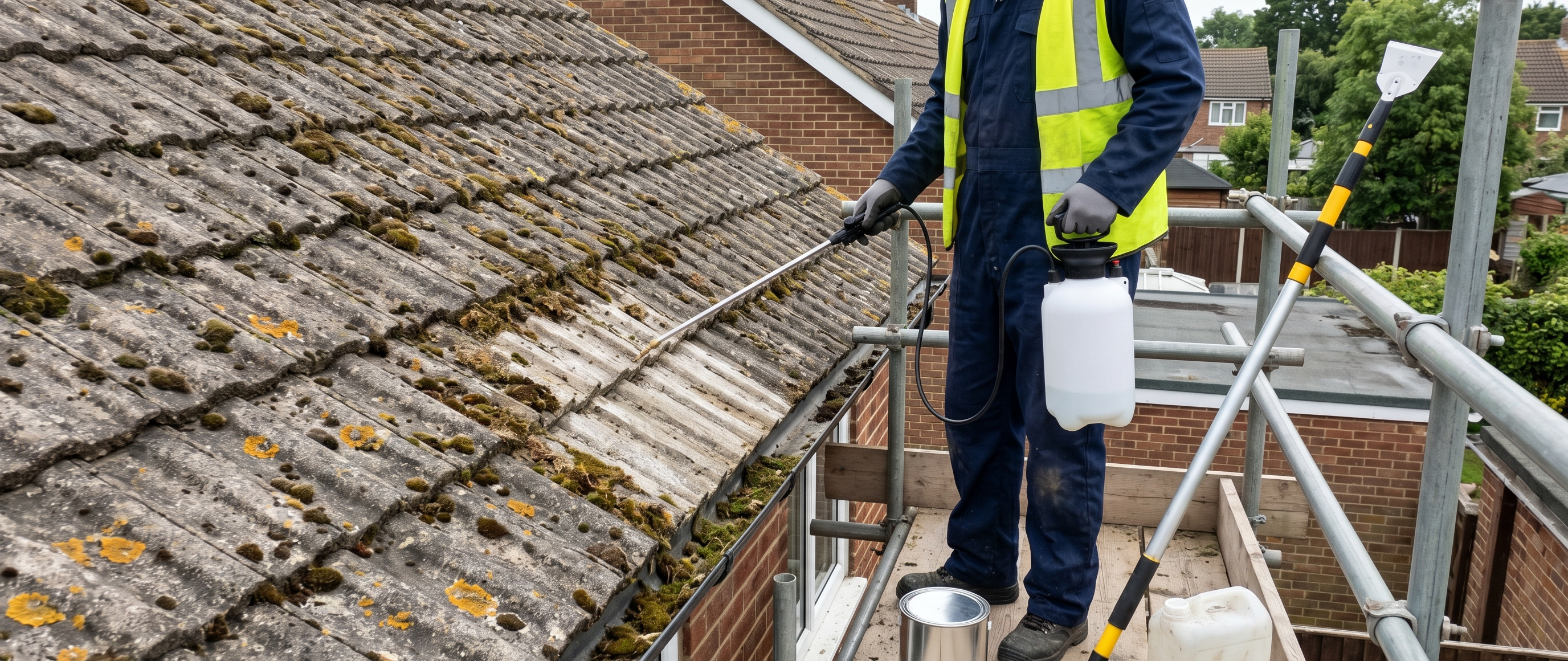
Vous devez enlever la mousse dense manuellement.
-
L'outil : Utilisez un grattoir de toit avec une tête profilée spécialisée. Vous pouvez acheter des lames de la forme exacte de vos tuiles (Marley, Redland, Roman, etc.).
-
La méthode : Grattez doucement la mousse pour la déloger. Elle tombe du toit dans la gouttière (assurez-vous de bloquer d'abord le tuyau de descente !).
-
L'avantage : Cela enlève 90 % de la biomasse sans utiliser une seule goutte d'eau ni de pression.
Étape 2 : Le traitement chimique (biocide)
Une fois les gros morceaux enlevés, les tuiles auront toujours l'air sales et pourront présenter des taches de lichen (croûtes noires/blanches/jaunes). Vous avez besoin d'un biocide (généralement du chlorure de benzalkonium ou du DDAC).
-
Application : Pulvérisez le liquide sur les tuiles sèches à l'aide d'un pulvérisateur de jardin à basse pression.
-
L'élimination : Le biocide pénètre dans les pores et tue les minuscules spores et les racines de lichen que le grattoir a manquées.
-
L'attente : Ce n'est pas une solution instantanée. Vous pulvérisez et laissez agir. Au cours des 3 à 6 prochains mois, les intempéries élimineront la décomposition morte du toit. Le toit sera plus propre chaque fois qu'il pleuvra.
L'effet autonettoyant
La beauté d’un traitement biocide réside dans son action de bouclier préventif.
-
Parce que vous n'avez pas décapé la surface de la tuile (comme le fait le nettoyage à pression), la tuile reste imperméable.
-
Le résidu chimique reste actif pendant 12 à 24 mois, ce qui signifie que la mousse ne peut pas repousser.
-
Un toit nettoyé à la pression redevient généralement vert en 12 mois. Un toit nettoyé en douceur reste propre pendant 3 à 5 ans.
Note sur la sécurité
Les chutes des toits sont une cause majeure de blessures graves.
-
Ne marchez jamais sur les vieilles tuiles : Elles sont fragiles et se casseront sous votre poids.
-
Travaillez à partir du niveau de la gouttière : Utilisez un échafaudage ou une échelle sécurisée.
-
Utilisez des perches télescopiques : Les perches télescopiques de grattage vous permettent d'atteindre le faîte depuis la sécurité de l'avant-toit.
Conclusion
Le lavage à haute pression est un « raccourci » agressif et destructeur. Le lavage doux est une solution douce et à long terme. Ne vieillissez pas votre toit de 20 ans juste pour le nettoyer le temps d'un week-end.
-
Grattez la mousse à sec
-
Imprégnez de biocide
-
Laissez les intempéries faire le reste
Partager:
Apprêter les tuiles poreuses : arrêter l’« effet éponge »
Réparer les rives et les faîtières maçonnées avant l'enduit