
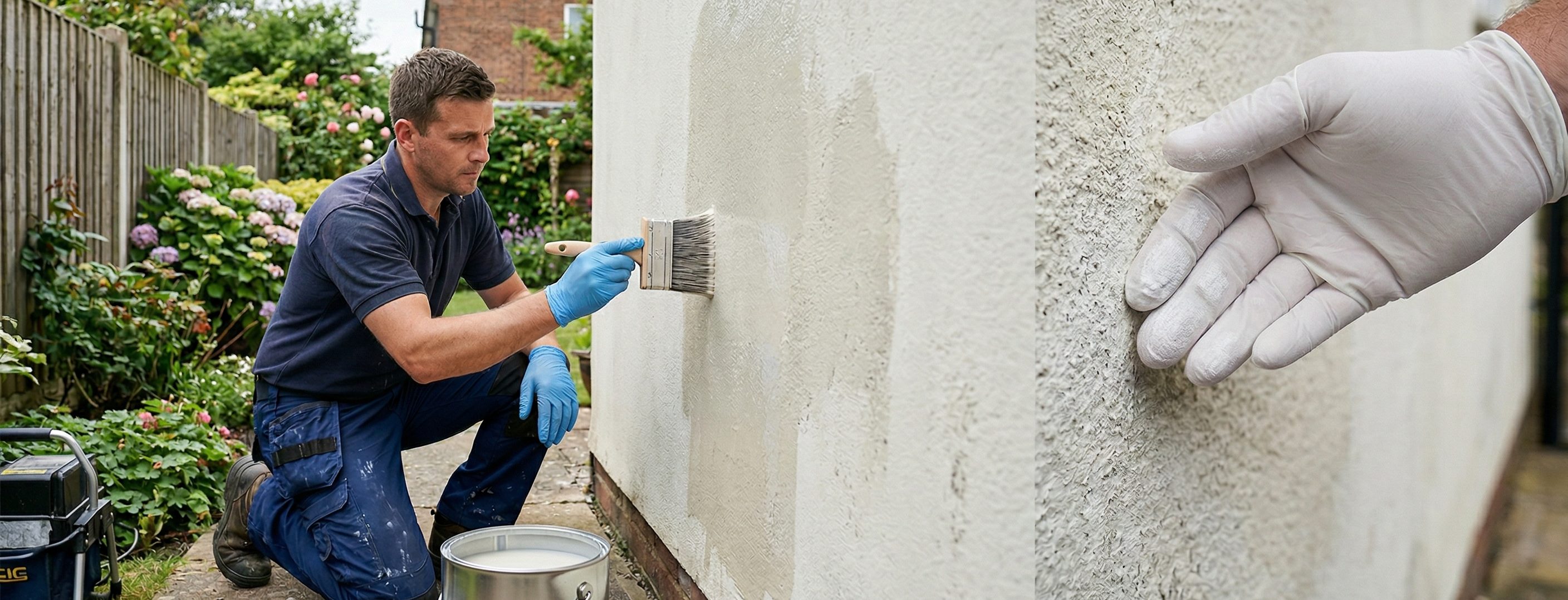
Vous êtes prêt à peindre l'extérieur de votre maison. Vous avez acheté la peinture de maçonnerie coûteuse. Votre échelle est prête. Mais lorsque vous passez la main sur le mur, votre paume est couverte de poussière blanche. Ou peut-être repeignez-vous un mur enduit, et l'ancienne peinture s'écaille en grandes plaques, révélant une surface sableuse et friable en dessous.
Arrêtez. Posez le pinceau. Si vous peignez sur une surface crayeuse ou poussiéreuse, votre nouvelle peinture ne tiendra pas. Elle pourrait paraître belle pendant un mois, mais dès qu'il pleuvra, elle boursouflera et s'écaillera. La peinture a besoin d'une surface solide pour adhérer. La poussière n'est pas une surface solide.
Vous devez fixer cette poussière avec un Primaire Stabilisateur. Voici comment utiliser cette colle invisible pour sauver votre travail de peinture.
1. Le problème : les surfaces « friables »
Dans le métier, nous appelons une surface poussiéreuse et friable « friable ». Cela se produit sur les vieux enduits, le béton et la maçonnerie en raison des intempéries. Le liant cimentaire se décompose au fil des décennies, laissant du sable et de la craie libres en surface.
Le test du ruban adhésif : Vous n'êtes pas sûr que votre mur soit friable ?
-
Collez un morceau de ruban de masquage ou de ruban adhésif sur le mur.
-
Arrachez-le rapidement.
-
Regardez le côté collant.
-
S'il est propre, vous pouvez peindre.
-
S'il est couvert de poussière, de sable ou de vieilles écailles de peinture, vous devez stabiliser.
2. La solution : Qu'est-ce qu'un primaire stabilisateur ?
Le primaire stabilisateur est un primaire transparent hautement pénétrant. Contrairement à la peinture normale (qui reste en surface), c'est un liquide fin conçu pour s'infiltrer dans le mur. Il contient des résines microscopiques qui voyagent profondément entre les grains de sable et de craie libres. En séchant, il durcit, collant les particules libres ensemble et formant une surface solide et non poreuse à laquelle la nouvelle peinture peut adhérer.
3. À base d'huile vs. à base d'eau : Le grand débat
Tout comme pour les scellants, vous avez deux choix chimiques.
Option A : Stabilisateur à base d'huile (solvant)
-
La « référence » : C'est ce que la plupart des décorateurs professionnels utilisent sur les murs en mauvais état.
-
Pourquoi ? Les solvants ont des molécules plus petites que l'eau. Ils pénètrent plus profondément dans le support. Ils sèchent également plus dur et lient plus fortement.
-
Idéal pour : Un enduit ou un crépi très ancien, fortement farineux, qui n'a pas été peint depuis 20 ans.
Option B : Stabilisateur à base d'eau (acrylique)
-
Le choix « moderne » : Ceux-ci sont plus sûrs à utiliser (pas d'odeur) et plus faciles à nettoyer.
-
La limite : Ils ont des molécules plus grosses. Ils restent plus proches de la surface.
-
Idéal pour : Les surfaces légèrement poussiéreuses ou le béton plus récent.
Conseil de pro : Si le mur est vraiment en mauvais état, utilisez toujours un produit à base d'huile. Idéalement, recherchez une formule solvant « séchage rapide » afin de pouvoir peindre par-dessus le même jour.
4. L'application : Ne créez pas un mur de verre
C'est l'erreur la plus courante commise par les bricoleurs. Le primaire stabilisateur n'est PAS un scellant. Vous ne voulez pas créer un film brillant, ressemblant à du verre, sur la surface. Si vous le faites, la peinture de maçonnerie glissera tout simplement.
L'objectif : Vous voulez que la surface soit « saine », pas « scellée ».
-
Préparation : Grattez d'abord toute la peinture écaillée. Le stabilisateur colle la poussière ; il ne recolle pas les éclats de peinture qui s'enroulent.
-
Application : Utilisez une large brosse ou un rouleau. Appliquez-le généreusement.
-
Le test du toucher : Pendant l'application, observez le mur.
-
S'il s'absorbe immédiatement, appliquez-en un peu plus.
-
S'il reste en surface et brille, arrêtez. Vous en avez trop appliqué. Étalez-le sur une zone sèche.
-
Séchage : Il sèchera généralement clair. Passez votre main dessus. Pas de poussière ? Parfait.
5. Puis-je utiliser simplement de la colle PVA ?
NON. N'utilisez jamais de colle PVA (colle blanche) sur un mur extérieur.
-
Elle est hydrosoluble : Quand il pleut, la colle PVA se liquéfie à nouveau. Votre peinture glissera littéralement de la maison.
-
Elle reste en surface : Elle ne pénètre pas comme un stabilisateur à base de solvant.
-
Elle pourrit : La colle PVA est un aliment pour les moisissures.
Le primaire stabilisateur est imperméable, respirant et résistant aux moisissures. La colle PVA n'a aucune de ces propriétés.
Conclusion
Peindre une maison est coûteux et dangereux. Vous ne voulez pas le faire deux fois. Le succès du travail dépend de la surface sur laquelle vous peignez. Si cette surface est poussiéreuse, vous construisez sur du sable.
-
Faites le test du ruban adhésif.
-
Imprégnez-le de stabilisateur.
-
Peignez en toute confiance.
Vous avez un mur crayeux ?
→ Découvrez notre primaire stabilisateur professionnel.
Partager:
Traitement des fissures capillaires : Pourquoi vous avez besoin d'enduits extérieurs souples pour la maçonnerie endommagée
Le test du ruban adhésif : diagnostiquer la maçonnerie instable avant de peindre