

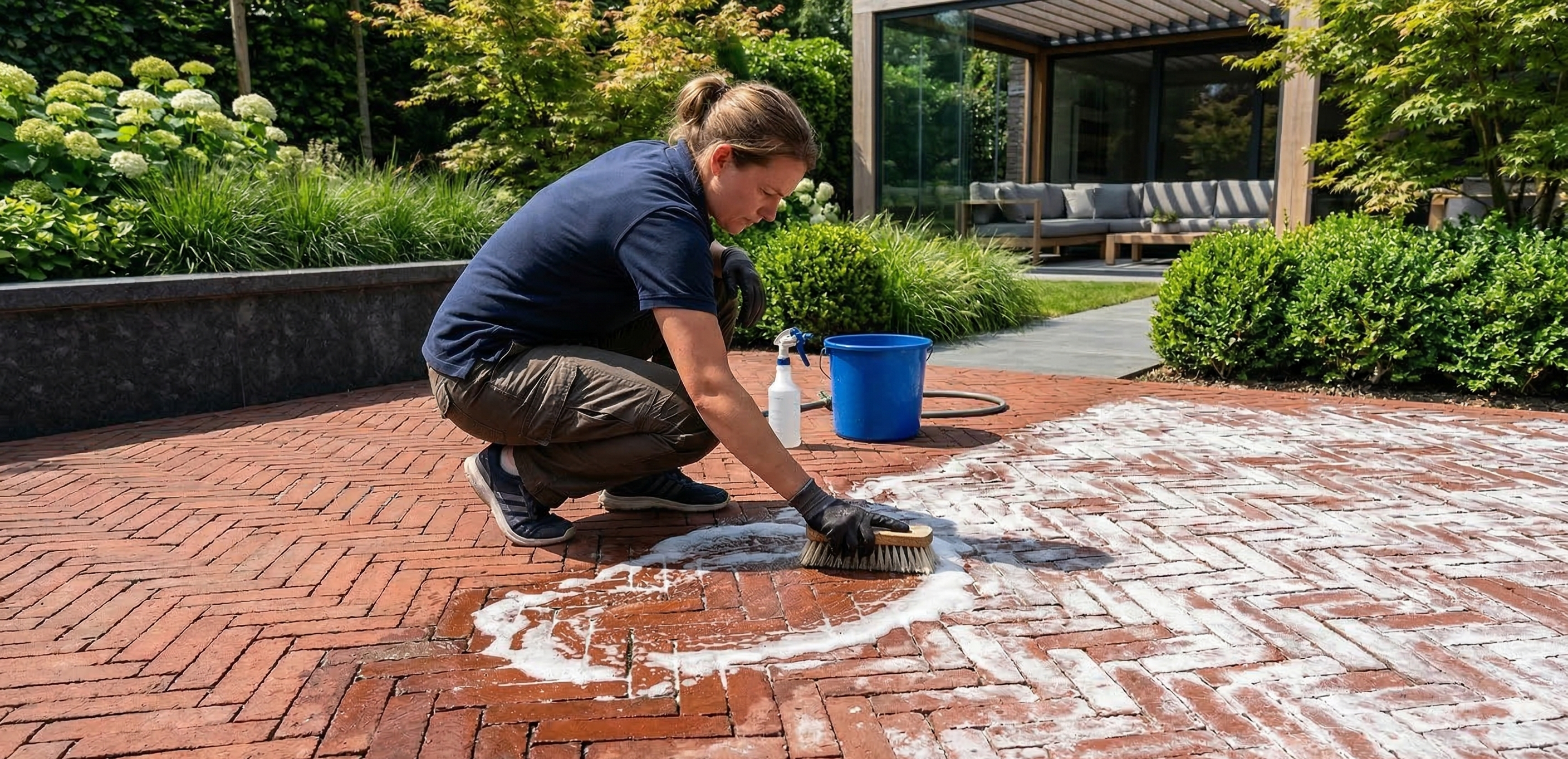
Vous avez scellé votre béton imprimé ou vos pavés. Le résultat était magnifique pendant 24 heures. Puis, après la première forte pluie ou une nuit froide, vous vous êtes réveillé face à un désastre. De grandes zones de l'allée ont pris une couleur blanche laiteuse et trouble. Cela ressemble à un sac en plastique flottant sur l'eau.
C'est ce qu'on appelle le « voile blanc » (ou la décoloration). La bonne nouvelle ? Votre scellant n'est pas défectueux, et vous n'avez probablement pas besoin de le décaper. La mauvaise nouvelle ? L'humidité est maintenant piégée dans le scellant.
Heureusement, les scellants à base de xylène (y compris les produits SummitSeal) ont un « bouton d'annulation » secret. Il s'agit d'un solvant puissant appelé xylène et d'un processus appelé ré-émulsification. Voici comment faire disparaître ce voile blanc et restaurer la finition transparente.
→ Achetez le produit de réparation pour scellant SummitSeal
1. La cause : le piège à humidité
Pour le réparer, vous devez comprendre pourquoi cela s'est produit. Le scellant acrylique à base de solvant forme un film plastique solide sur le béton.
-
Scénario A (Béton humide) : Vous avez scellé le béton alors qu'il était encore légèrement humide à l'intérieur. Lorsque le soleil a frappé l'allée, l'eau s'est transformée en vapeur et a essayé de monter. Elle a frappé le dessous du scellant, s'est coincée et a séparé la résine du béton. Le « blanc » que vous voyez est l'espace microscopique entre le scellant et le sol – une poche d'air littérale.
-
Scénario B (Trop épais) : Vous avez appliqué le scellant trop épais. La surface s'est solidifiée avant que les solvants en dessous ne puissent s'évaporer. Les solvants se sont retrouvés piégés, créant des bulles troubles.
2. La solution : la ré-émulsification
Vous n'avez pas besoin de poncer le scellant. Il vous suffit de le ramener à l'état liquide pendant 30 minutes.
Les scellants à base de xylène peuvent être refondus par leur propre solvant porteur. Lorsque vous appliquez du xylène pur sur le scellant blanc durci :
-
Il ramollit la résine dure, la ramenant à l'état liquide.
-
Comme le scellant est à nouveau liquide, l'humidité piégée ou les bulles d'air peuvent remonter à la surface et s'échapper.
-
Le xylène s'évapore et la résine se redépose, adhérant fermement au béton – cette fois-ci claire et transparente.
3. Avertissement important : Connaissez votre scellant
STOP. Avant d'acheter du xylène, vérifiez quel scellant vous avez utilisé.
-
Acrylique à base de solvant : OUI. Cette astuce fonctionne parfaitement.
-
Scellant à base d'eau : NON. Le xylène ne réglera pas le problème; il pourrait l'aggraver.
4. Le guide étape par étape
Étape 1 : Attendre un temps sec
N'essayez pas si de la pluie est prévue ou si le sol est mouillé. Vous essayez d'éliminer l'humidité, pas d'en ajouter. Choisissez une journée chaude et sèche.
Étape 2 : L'application
Sécurité : Le xylène est inflammable et dégage une forte odeur. Portez un masque respiratoire (vapeurs organiques) et des gants résistants aux solvants.
-
Versez le xylène dans un bac métallique ou utilisez un pulvérisateur résistant aux solvants.
-
Appliquez une fine couche de xylène sur les zones blanches affectées.
-
Observez : Vous devriez voir le voile blanc disparaître presque instantanément à mesure que le scellant se liquéfie à nouveau.
Étape 3 : Agitation (La clé)
Ne vous contentez pas de pulvériser et de vous en aller.
-
Utilisez un balai à poils durs ou un rouleau.
-
Faites pénétrer le xylène dans la surface. Cette action mécanique aide à briser la tension superficielle et garantit que l'ancienne résine se mélange complètement au nouveau solvant.
-
Cela « masse » les poches d'air pour les faire sortir.
Étape 4 : Laissez agir
Une fois la zone agitée, arrêtez. Laissez le solvant s'évaporer naturellement. Selon la température, le sol restera collant pendant 30 à 60 minutes. Ne roulez pas dessus pendant 24 heures.
5. Que faire si ça ne fonctionne pas ?
Si vous appliquez du xylène et que le voile blanc réapparaît après séchage, l'une des deux choses suivantes se produit :
-
Trop d'eau : Le sol est encore saturé. Vous devez attendre une période de temps chaud pour que la dalle sèche avant de réessayer.
-
Trop épais : La couche de scellant d'origine est tout simplement trop épaisse pour que le xylène puisse la pénétrer. Vous devrez peut-être utiliser un décapant de scellant plus puissant pour enlever une partie de l'épaisseur avant de resceller.
Conclusion
L'apparition d'un voile blanc semble catastrophique, mais pour les acryliques à base de solvant, il s'agit généralement d'une solution de 20 minutes. Vous réinitialisez essentiellement le processus de durcissement.
-
Vérifiez qu'il s'agit d'acrylique à base de solvant
-
Attendez un jour sec
-
Faites-le fondre avec du xylène
Besoin de réparer une allée laiteuse ?
→ Procurez-vous une boîte de fluide de réparation pour scellant.
Partager:
Guide de sensibilité à l'acide : Nettoyage sécurisé du calcaire et du travertin
Traitement de la mousse et des algues sur les surfaces de goudron souples