

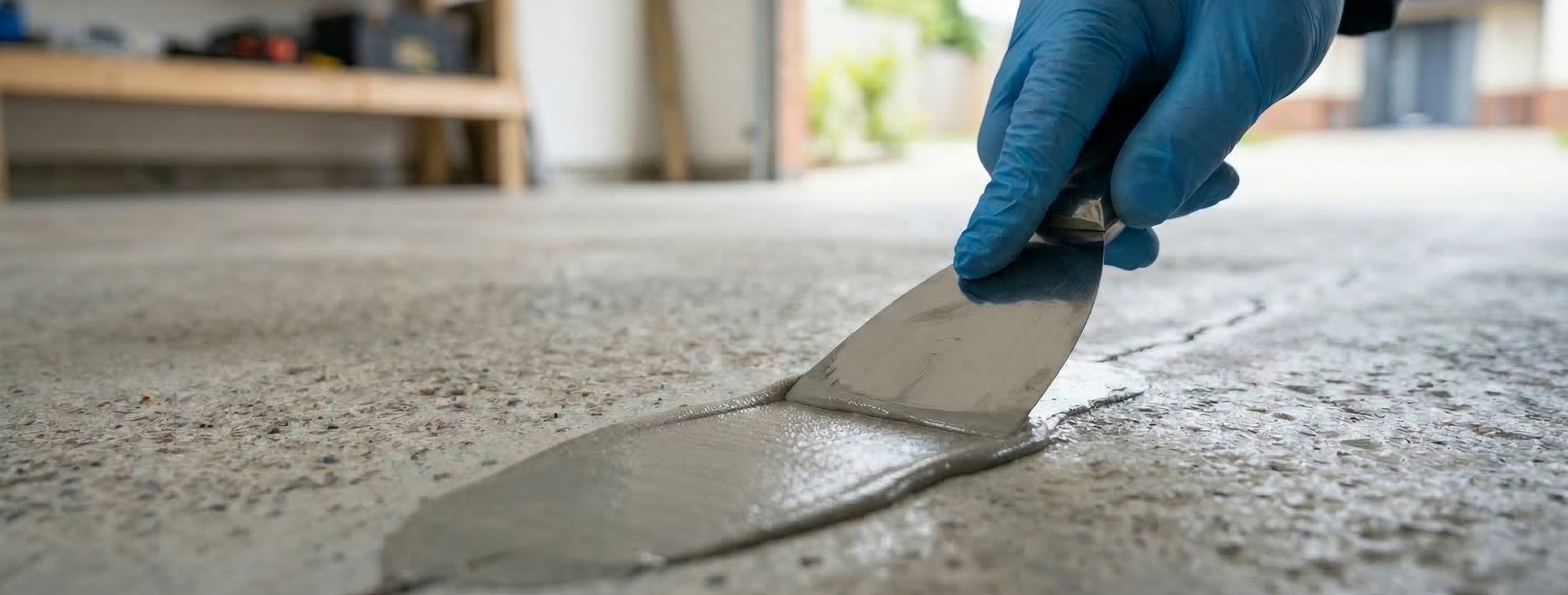
La peinture est un revêtement, pas un enduit de rebouchage.
C'est la leçon la plus difficile à apprendre pour les bricoleurs. Si vous appliquez une nouvelle peinture époxy pour sol brillante sur une fissure, la peinture s'y enfoncera. En une semaine, cette fissure transparaîtra à travers le revêtement, vous laissant avec un sol magnifiquement peint mais fissuré.
Pire encore, si vous utilisez un enduit de rebouchage bon marché à base d'eau provenant d'un pot, la résine lourde l'arrachera de la fissure au fur et à mesure qu'elle durcira.
La réparation des fissures et des cavités du béton est obligatoire si vous souhaitez une finition sans raccords. Mais vous devez utiliser les bons matériaux, et plus important encore, vous devez savoir quelles fissures ne doivent pas être remplies.
Étape 1 : Diagnostic
Avant de mélanger tout enduit, examinez le sol.
-
Fissures aléatoires : Ce sont des lignes irrégulières causées par le retrait ou le tassement. REBOUCHEZ-LES.
-
Cavités et épaufrures : Petits cratères où la surface du béton s'est détachée. REBOUCHEZ-LES.
-
Joints de dilatation : Ce sont les lignes droites, sciées, qui traversent la dalle. NE LES REMPLISSEZ PAS.
-
Pourquoi ? : Ces coupes sont là pour permettre au béton de se dilater et de se contracter avec la chaleur. Si vous les remplissez avec un mortier rigide, le béton n'aura nulle part où se déplacer, et il se fissurera ailleurs. Laissez-les ouverts ou utilisez un mastic de joint flexible après la peinture.
Étape 2 : Préparation
Vous ne pouvez pas simplement étaler de l'enduit sur une fissure fine. Il ne pénétrera pas assez profondément pour adhérer.
-
Pour les fissures : Vous devez "chasser" la fissure. Utilisez une meuleuse d'angle avec un disque diamanté ou un marteau et un burin pour élargir la fissure en forme de "V". Cela donne au mortier de réparation époxy une surface solide à laquelle s'accrocher.
-
Pour les cavités/trous : Brossez les débris détachés. Aspirez soigneusement la poussière. S'il y a de la poussière, le patch ne collera pas.
Étape 3 : Choisissez votre outil
Rangez le pot d'enduit mural prêt à l'emploi. Il est trop mou pour un sol.
-
Pour les petites cavités et les fissures capillaires : Utilisez un mastic polyester bi-composant de grain fin (similaire au mastic de carrosserie) ou une pâte époxy thixotrope.
-
Pour les grands trous et les fissures profondes : Vous avez besoin d'une résistance structurelle. Utilisez un mortier de réparation époxy industriel. Il s'agit d'une résine bi-composant mélangée à du sable fin. Il durcit plus que le béton lui-même et ne rétrécit pas.
Étape 4 : L'application
Les produits de réparation à base de résine ne rétrécissent pas beaucoup, mais ils se tassent.
-
Primaire (facultatif) : Certains mortiers nécessitent une couche d'accrochage de primaire. Vérifiez la boîte.
-
Remplir : Appuyez fermement le mortier dans la fissure pour chasser les poches d'air.
-
Trop remplir : Laissez le patch légèrement plus haut que le sol environnant.
-
Lisser : Passez la truelle, mais n'essayez pas de le rendre parfaitement affleurant pour l'instant.
Étape 5 : Le ponçage
Une fois que le patch a durci (généralement 2 à 6 heures pour les mortiers époxy), il sera très dur. Utilisez une meuleuse d'angle avec une coupelle de ponçage ou une ponceuse robuste pour poncer le patch à fleur du sol.
-
Le test : Passez votre main sur la réparation les yeux fermés. Si vous pouvez sentir la bosse, vous la verrez une fois peinte. Continuez à poncer jusqu'à ce qu'elle disparaisse.
Conclusion
Un guide de réparation du béton est vraiment une leçon de patience. Il est tentant de sauter les travaux de réparation pour arriver à la "partie amusante" de la peinture, mais le patch est la base du sol.
Si vous avez un sol qui ressemble à la surface de la lune, n'essayez pas de réparer chaque trou. Envisagez d'utiliser un composé auto-nivelant pour resurfacer toute la zone avant d'appliquer votre peinture pour sol à forte épaisseur.
N'oubliez pas que si vous utilisez un composé auto-nivelant, vous devrez le décaper avant de pouvoir appliquer de la peinture.
Partager:
Le guide ultime de la préparation du sol de garage DIY : nettoyage, réparation et profilage
Traiter le « farinage » du béton : durcir les surfaces faibles