

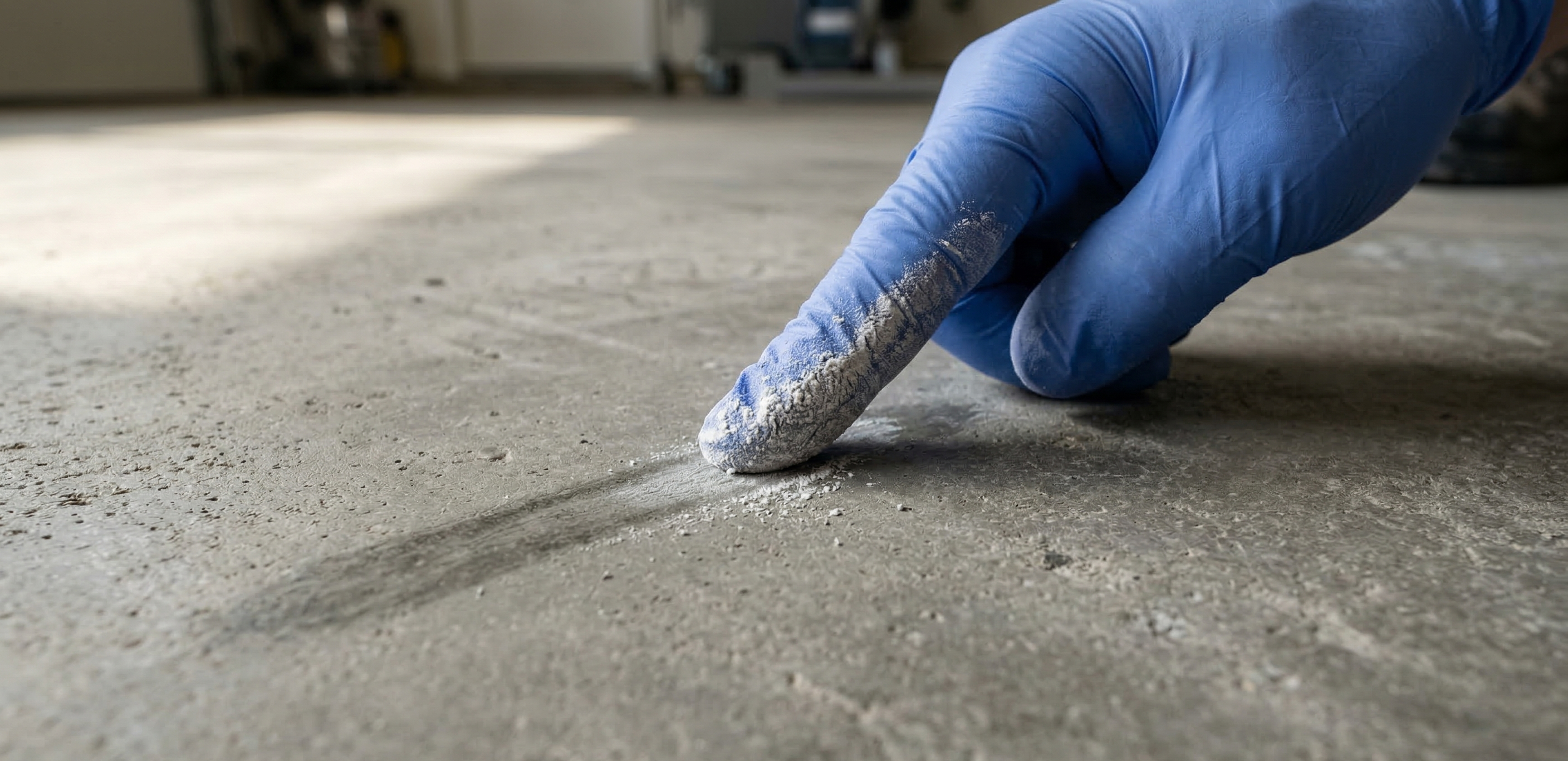
If you have just poured a new concrete floor, it probably looks perfect. It’s smooth, light grey, and feels like glass to the touch.
Unfortunately, that smooth surface is not concrete. It is laitance. And if you paint directly over it, your floor will fail. We see this mistake all too often.
Laitance is the silent killer of resin floors. It is the number one reason we see brand-new Epoxy Floor Coatings peeling off in sheets within six months.
To understand why, you need to look at what happens when concrete cures.
What Actually is Laitance?
Concrete is a mix of heavy aggregate (stones), sand, cement, and water. When wet concrete is poured and trowelled, the heavy stones sink to the bottom. Meanwhile, the excess water and fine cement particles rise to the top.
As the water evaporates, it leaves behind a thin, milky layer of weak cement on the surface. This is laitance.
-
Thickness: Usually 0.5mm to 2mm
-
Strength: Very weak and brittle
The "Sticky Tape" Trap
Here is why laitance is so dangerous: It looks solid. If you apply a high-strength Industrial Floor Paint to laitance, the paint will stick to it perfectly. The bond is strong.
But, when you drive a car over that paint, the stress travels through the coating and hits the concrete. Because the laitance is weak, it snaps away from the main slab. The paint hasn't failed - the concrete surface has failed. When you peel up the flake of paint, look at the back of it. You will see a thin layer of grey dust stuck to the resin. That is the laitance that ripped loose.
How to Test for Laitance (The Scratch Test)
You don't need a lab coat to find it. You just need a key or a screwdriver.
Find a discreet corner of the floor and scratch the surface firmly.
-
If you scratch it easily and it produces a fine, white powder: You have laitance. It is too soft to paint.
-
If the metal leaves a grey mark but doesn't gouge the floor: You have a hard, sound surface (or a hardener was applied).
How to Remove Laitance
You cannot sweep or vacuum laitance away. It is physically part of the floor. You must remove it to expose the strong aggregate underneath.
Option 1: Acid Etching (The DIY Method)
For residential garages, Acid Etching is often sufficient to dissolve the weak cement layer.
-
Note: You must use a stiff broom to scrub the acid while it fizzes. If you just pour it and leave it, it won't cut deep enough.
Option 2: Mechanical Grinding (The Pro Method)
For commercial warehouses or factory floors, acid is too risky. You need Diamond Grinding. A floor grinder physically scours the top 1-2mm off the surface. This guarantees the laitance is gone and leaves a "keyed" profile that your Epoxy Primer can lock into.
Conclusion
Painting new concrete requires patience. You typically need to wait at least 28 days for the fresh concrete to cure, and then you must remove the cream.
Don't fall for the trap of a "smooth" floor. If you want your paint to stick for years, you need to get down to the real concrete.
Once the laitance is gone and the dust is vacuumed, seal that fresh surface immediately with our Polyurethane Primer & Sealer.
Share:
How to Clean Oil-Contaminated Concrete for Floor Paint
The Moisture Test: How to Check Your Garage Floor for Damp